Sunday, February 24, 2019

'Suspected vandalism in Hampi temples' - by K J S Chatrath


About three weeks back I spent three days in Hampi in Karnataka, India, on a personal trip and visited a number of monuments there. 

During the course of my visits to some of these monuments, I noticed that some carvings seemed to have been disfigured partially by the vandals. I have no expertise in the matter but to me as a layman, some of the disfiguring seems to be of recent origin. I am attaching herewith some of the photos that I took of such carvings on 24th and 25th January, 2019. 

May be these are old disfigurements and I am totally wrong. I sent an email with those photos to DG Archeological Survey of India on 7.2.2019 and am awaiting an acknowledgement.  I think it is my duty to bring this apprehension to the notice of my readers and lovers of India’s heritage.  


Saturday, February 23, 2019

Indian postage stamps on hill forts of Rajasthan- K.J.S.Chatrath


Indian Postal Department deserves to be complimented for bringing out these excellent theme based stamps.

Those interested in further information may like to access UNESCO's website: 
https://whc.unesco.org/en/list/247

One may also like to see my earlier photo articles:

'Indian fashion through the ages, Series- I, postage stamps' - by K J S Chatrath.

Saturday, February 16, 2019

'There is much more to Khajuraho temples besides eroticism, Part-I' - by K J S Chatrath


The Khajuraho Monuments are a group of Hindu temples in Chhatarpur, Madhya Pradesh, India, about 175 kilometres southeast of Jhansi. They are one of the UNESCO World Heritage Sites in India. The temples are famous for their nagara-style architectural symbolism and their erotic sculptures.

These temples were built during the Chandella dynasty, between 950 and 1050. Only about 20 temples remain; they fall into three distinct groups and belong to two different religions – Hinduism and Jainism. They strike a perfect balance between architecture and sculpture

Rich in historical myths, stories, artistic creativity and architectural marvel, these temples are a representative of the art and architecture of ancient India  These  sculptures depict various scenes from everyday lives and various  human emotions.
  
They also seem to celebrate women in her varied forms. They are depicted as yawning, scratching, disrobing, removing thorn from feet, playing with babies and pets like parrot, looking at mirror to do make-up etc.

These temples are often mistakenly depicted as erotic temples and other nuances are over looked. In fact erotic art constitutes only 10% of the total sculptures of Khajuraho. This is an interesting case where the 10% overshadows the remaining 90%!

In this presentation I am not presenting any aspects of erotic art or even of the female form but of other varied aspects.* Take a look:


This show an intriguing scene. What are they carrying- a baby? No, a load of stones? Any guess.

I could not decipher this one. Two holy men in a discussion? Perhaps!

Narashima.

Lord Vishnu


Depicting camels in a temple in the midst of thick forests showing fairly extensive human movements between various areas.

After this one, move over to the next photo showing a closer view from a slightly different angle.


Crows will be crows! I 'caught' this one doing his thing atop one of the temples.


(Write up based on information from UNESCO & MPtourism websites)

Thursday, February 7, 2019

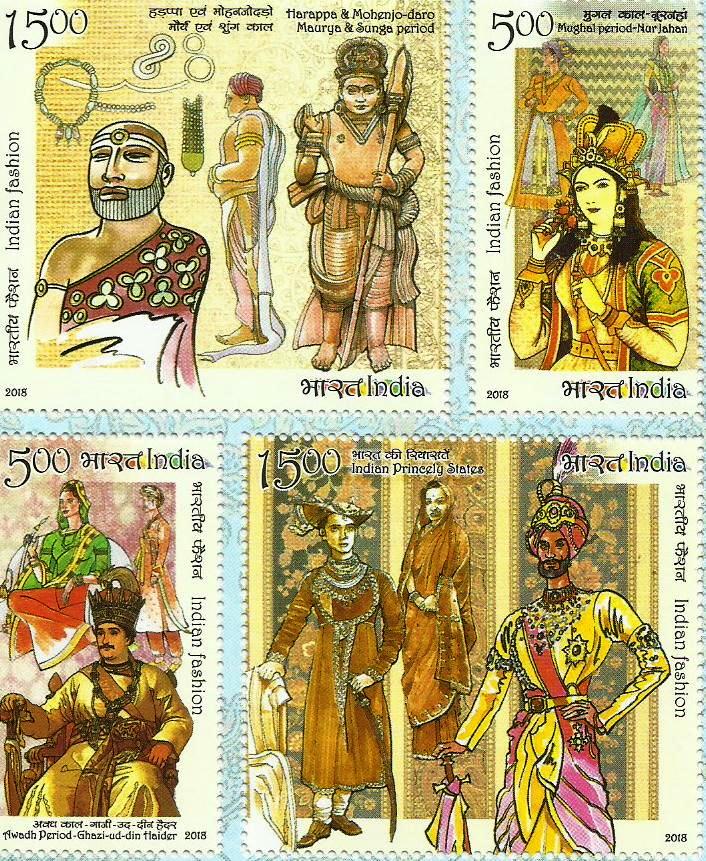
'Indian fashion through the ages, Series- I, postage stamps' - by K J S Chatrath


I have many reasons for visiting Bengaluru in Karnataka, one of those being the desire to visit the philately wing at the General Post Office.

So last fortnight I was there, once again sitting in front of the philately desk. Also sitting was a youngish gentleman with his little 8-9 year old daughter. He introduced himself and told me that he was very happy to see old people like me taking interest in Indian postage stamps. He went on to add that he had come to get his daughter registered in the philately wing so that she gets new stamps as an when those are issued, after all, this is a nice way to know your country, is it not, he asked? I nodded in agreement and complimented him for inculcation such values in her daughter. He then went about the task of depositing Rs.5000/- towards registration and membership.

I on my part bought all the new stamps that I had not seen earlier. I would love to share those with my readers as, quite sadly letter writing and posting letters affixing postage stamps has quietly gone out of vogue. And what a loss!

Here is the first part of such sharing. Indian Postal Department deserves to be complimented for bringing out such lovely stamps.

Come, visit my India!

Saturday, December 1, 2018

'Rameswara (Mausi Ma) Temple, Bhubaneswar' - by KJS Chatrath


In February 2017, I had the privilege of visiting Bhubaneswar again after a few years. I was able to spend some time visiting some of the may temples of Odisha, some of which I had visited for the first time in 1968. One such temple that I visted was Rameswara temple. I was straight away impressed by two things- a nice signboard in Odiya and English and secondly that  the environs were maintained neat and clean.

 
Now about the background of this temple. Legend goes that when Lord Rama was returning from Lanka after victory over Ravana, Goddess Sita wanted to worship Lord Shiva here. So Rama built a Linga for that purpose.


Traditionally during Ashokashtami, which falls one day before the Rama Naumi in the month of Chaitra,  Lord Lingaraja comes to this temple  in a colourful procession on a large chariot called Rukuna Rath and stays here for four days before returning in the chariot to Lingaraj Temple. In this procession, bronze images of three deities―Chandrasekhar (the representative of Lord Lingaraj), Rukmini and Basudeva are taken to Rameshwar Temple  


This temple is also known as Mausi Maa temple.  Rameswara Temple is just two kms away from Lingaraj temple. The temple houses a Shiva Linga within a circular yonipitha made of chlorite. There is also an image of Goddess Durga that is worshipped within the sanctum. The Jagamohan (assembly hall) of the temple was built much later. While some historians say that the temple was built during the late Soma Vansh period that can be traced to the early part of the 12th century AD, others date it back to the 9th century AD.


(Text with inputs from the internet)

Chatrath's Photo Album: A look at awesome Ajmer................by K J S Chatrath

                   All photos by K.J.S.Chatrath. Photos of the holy Ajmer Sharif Dargah would follow.