Tuesday, September 4, 2018

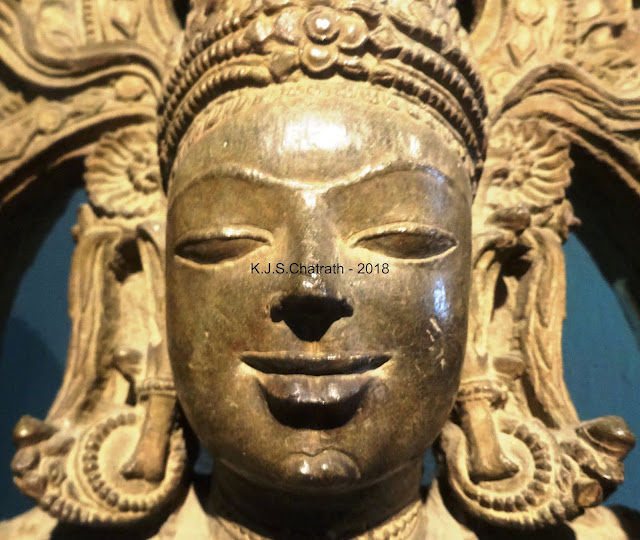
'64 Yogini Temple, Hirapur, Odisha' - by K.J.S.Chatrath

Kindly see my two earlier photo articles on this amazing temple:


'64 hairstyles of 64 (Chausath) Yoginis in Hirapur temple, Odisha, Part-I' by K.J.S.Chatrath ;

'64 hairstyles of 64 (Chausath) Yoginis in Hirapur temple, Odisha, Part-II' by K.J.S.Chatrath; http://indianheritagephotos.blogspot.com/2017/06/64-hairstyles-of-64-chausath-yoginis-in_5.html


Tuesday, July 10, 2018

'Ornaments of Lord Vishnu' - by K.J.S.Chatrath


I came across this wonderful statue of Lord Vishnu from Konark, Odisha, 13th century, Ganga Dynasty at the National Museum, New Delhi.

Vishnu iconography shows him with a dark blue, blue-gray or black colored skin, and as a well dressed jeweled god. He is typically shown with four arms. Lord Vishnu is known to be “Alankara priya”- One who loves to be adored with flowers and ornaments. He is said to be one 'who is blazing with the countless Divine Ornaments: the Crown, the Diadem; and, for the head, ears, neck, breast, arms, wrists, waist and ankles, such (jewels) as Cudavatarhsa, Makara-kundala, Graiveyaka-hara, Keyura, Kataka, Shri-vatsa, Kaustubha, Mukta-damodara-bandhana, Pitambara, Kanchiguna, Nupura etc.'  (https://hinduism.stackexchange.com/questions/16157/what-scriptures-describe-vishnus-mukta-damodara-bandana)  ;While there are descriptions of his conch shell, gada etc, I have not been able to find detail descriptions  of the jewels adorning him and what they represent.

Take a look at the photos of this statue and see if you can locate something significant:

The necklace seems to be studded with precious stones- emeralds and rubies, perhaps? There seems to be some unevenness in the fourth row from the top.

 The lower cloth and the ornaments show the work of craftsmen of Odisha in the 13th century. Here too the number of beads in the hanging ornament are different in number when one compares the right and the left sides of the ornaments. It is impossible to imagine that the master craftsmen of the time erred.Was there a reason which we have not been able to discover as yet?

The lines seem to indicate a fine cloth. But the more impressive part is the garland which is not hanging from theneck but is shown tossed around from one side moving to the back. The armlets are heavy and neatly crafted.


It is not clear what do these ear rings look like but Lord Vishu's earrings are said to be shaped like Makara the sea monster (makara-kundala).

I would welcome inputs on this topic of ornaments of Lord Vishnu.

Wednesday, May 23, 2018

'Chitrakarini temple, Bhubaneswar, Part-II' - by K.J.S.Chatrath


'Chitrakarini Temple, Bhubaneswar, India' - by K.J.S.Chatrath

 
 One place you must go before you  die is Odisha and visit Lord Jagannath's Temple at Puri, Konark Temple at Konark and and Lord Lingraj Temple at Bhubaneswar.

How ever Bhubaneswar is not a one temple town. There are more than a thousand old temples, in various stages of repair and disrepair in Bhubaneswar. Ever few hundred metres you would come across a temple. The sheer grandeur of Lingraj temple attracts most of the attention and one tends to ignore other temples- each an architectural gem in itself.
 Source of the above: Google maps


I visited Bhubaneswar in January 2017 and visited one such temple-  the Chitrakarini temple.


This Kalinga Nagara style temple is well preserved small lawn. It is being maintained by the  Archeological Survey of India (ASI). Lingaraj and Chtrakarini temples share a common boundary wall and one can have a panoramic view of the former from here.

Built in 13th century CE, the rich stone carvings depicting flowers, creepers, erotic couples, dancers, lions controlling elephants adorns the outer walls of the shrine. The main shrine is surrounded by four subsidiary small shrines in four corners. Chamunda is the presiding deity of the min shrine and Shaktism is the conduct of worship followed at this shrine.
The Chitrakarini temple, with four subsidiary shrines at the corners, is of the 'Panchayatana' (five-shrined) type, the whole group enclosed by a compound-wall. It is built on a low undecorated platform with projections, it is 'Pancha-Ratha' on plan, with a division of the corner 'Ratha' all through.

The decoration of the roof of the 'Jagamohana' is a departure from the established type; the 'Pidhas' are arranged in two tiers as usual, but on each tier there is a row of replicas of the pyramidal roof, one on each projection.
Two of the friezes, both of them depicted on the lintels of the non-functional banister windows of the 'Jagamohana', deserve special attention; the one on the south side depicts a marriage, probably of Shiva and Parvati, while that on the north shows Krishna playing on his flute amidst his enchanted followers and cattle listening with rapt attention. Of the three overhanging mouldings above the south lintel, the highest is prominent for a procession counting riders on camels.


Do not miss the camels and the implication of this depiction, as camels are not found in Odisha. 


Intricate stone work


An old 1890 photo of the Chitrkarini Temple by William Temple Cornish (Source: British Library)
(Text with inputs from the internet)


Wednesday, May 16, 2018

'Tabla performance by Ms. Rimpa Siva at India International Centre, New Delhi' - K.J.S.Chatrath


 I was fortunate to attend a tabla performance by Ms. Rimpa Siva at India International Centre, New Delhi earlier this month.

I recorded a part of it and have uploaded it on You Tube. Take a look:
https://youtu.be/Y9_FZBo9WDU


Rimpa Siva was taught to play the Farukhabad gharana style by her father Prof. Swapan Siva.  She  started her stage performances when she was eight years old. She now stands out as one of the few female tabla players in the Indian classical music landscape. Her passion for tabla has earned her numerous laurels and she was featured in a French documentary titled Rimpa Siva: Princess of Tabla.  

Sunday, May 13, 2018

'Indian heritage in Cambodia- some photos' - by K.J.S.Chatrath


May I invite you to see my earlier post on Cambodia: 'Cambodian dances & music' - by K.J.S.Chatrath.   by clicking at the following link:   http://fiftyplustravels.blogspot.in/2017/10/cambodian-dances-music-by-kjschatrath.html


 Those interested in knowing about the Hindu heritage of cambodia may like to read "Cambodia’s Hindu heritage continues to loom large" - By Murali Balaji;
https://www.huffingtonpost.com/murali-balaji/cambodias-hindu-heritage_b_13792554.html


The Last Post: Inscriptions on French Graves in India.....by K J S Chatrath

Perhaps the only book on the subject in English, French or in any other language. With a learned foreword by the famous French historian and...