Saturday, January 14, 2017

'Odisha- the one place you must visit before you die' by K.J.S.Chatrath

It has become a cliche' to say that you must visit these ten or twenty or hundred places before you die. Having visited a few places across the world, I would say that Odisha is the one place one must visit before one dies.

I worked in Orissa for 35 years and left the state on retirement in 2003, but my hunger for visiting various places in this wonderful state has not yet got satiated.

I am just back after a one week trip to Odisha during which I visited the State Museum and various temples at Bhubaneswar, then the Budhist sites of Lalitgiri, Ratangiri and Udaygiri. And   moving towards Konark, the Chausath Yogini Temple  and ofcourse the Konark temple and the Museum there.

I would be posting many write-ups and photos taken during this visit. But here are just a few photos to whet the appetite.....

 Mukteshwar temple, Bhubaneswar.
 
Lalitgiri.

 Chausath Yogini temple near Bhubaneswar. Each of the 64 'yoginis' sports a different hairstyle.

 Konark.

  Konark.

Thats a tired looking me at Ratangiri.

Saturday, December 31, 2016

'Fearsome Chamunda statue in Bhopal Museum' - by K.J.S.Chatrath

I recently visited the Stater Museum, Bhopal.


 Statue of Chamunda, circa 11th century A.D., discovered in Chaurasigarh, Mandsaur district, Madhya Pradesh. On display in the State Museum, Bhopal, India.


Chamunda, also known as Sachchi Mata, Chamundi, Chamundeshwari and Charchika, is a fearsome aspect of Devi, the Hindu Divine Mother and one of the seven Matrikas (mother goddesses). She is also one of the chief Yoginis, a group of sixty-four or eighty-one Tantric goddesses, who are attendants of the warrior goddess Durga.


The name is a combination of Chanda and Munda , two monsters whom Chamunda killed. She is closely associated with Kali, another fierce aspect of Devi. She is sometimes identified with goddesses Parvati, Chandi or Durga as well. The goddess is often portrayed as haunting cremation grounds or fig trees.

(Text based on information in Wikipedia)

Monday, December 26, 2016

Friday, December 23, 2016

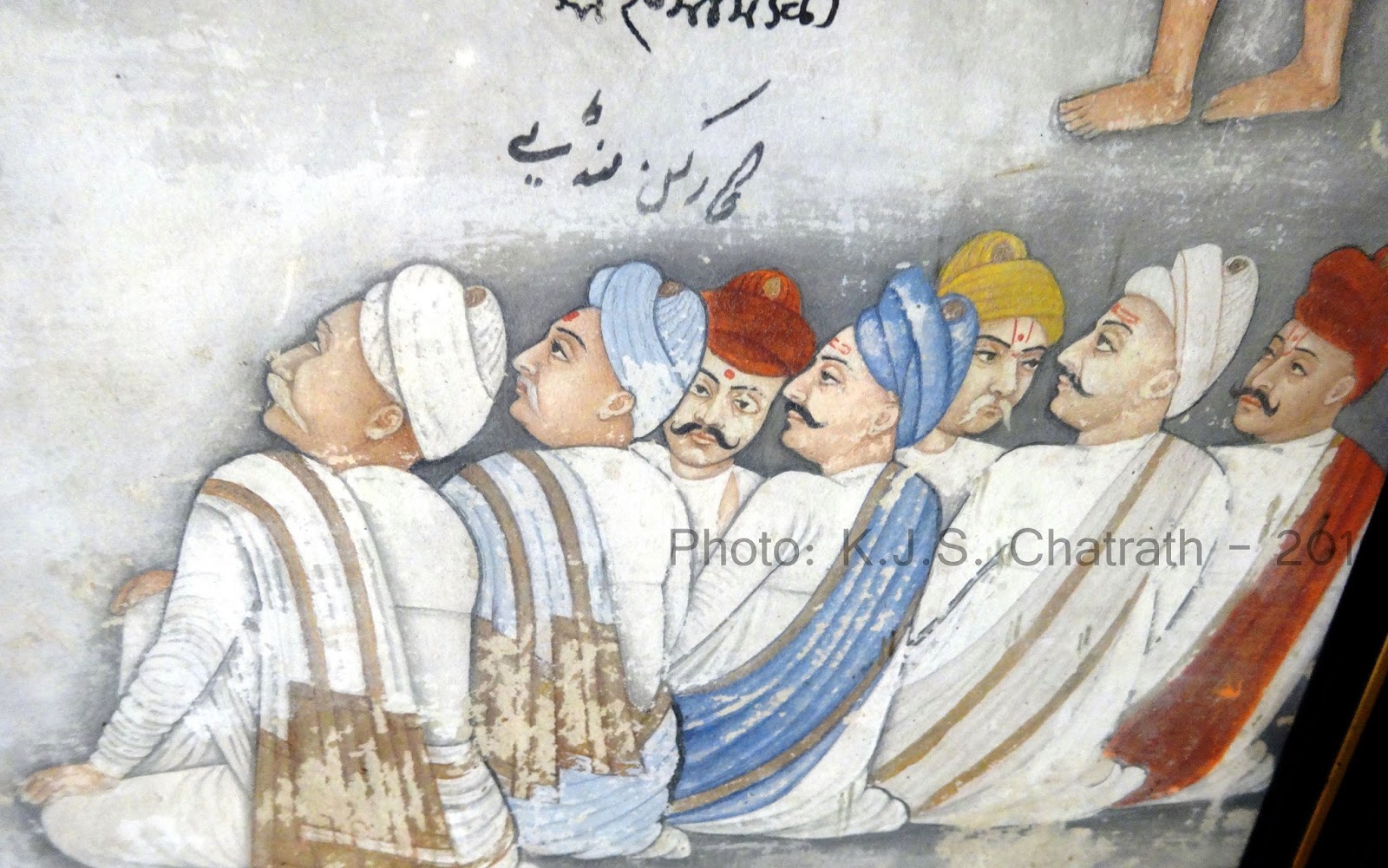
'A 19th century painting on display in Bhopal Museum depicting the darbar of Jiwajirao Scindia, Part-I' - by K.J.S.Chatrath


An impressive old painting from the 19th century showing the Darbar of Jiwaji Rao Scindia, which I saw in the Bhopal Museum, India, last week. I took 20 separate photos focussing on various parts of this painting.

Sadly, I could not find out anything about the talented painter who created this work.


The challenge is to concentrate on each photo and try to decipher what all it tells us of that epoch in history. See the variety of dresses, moustaches, sideburns, beards, headgears, male jewelry etc.The painting shows only males and no ladies.

(Continued)

Thursday, December 22, 2016

'A 19th century painting in Kangra style and its poorly worded explanation in Bhopal Museum, India.' - by K.J.S. Chatrath


A 19th century painting in Kangra style and its very poorly worded explanation in Bhopal Museum, Bhopal, India.

' A stunning statue from 11th century on display in Bhopal Museum, India' by K.J.S.Chatrath

Last week I visited the Bhopal Museum in Bhopal, Madhya Pradesh, India, and was greatly impressed. There is a nominal ticket costing Rs.5 and an additional Rs.50 if one wants to take photographs.

Here are four photos of 'Nayika' dating back to circa 11th century A.D. which was discovered in Morena. These photos were taken from different angles in order to appreciate the superb craftmanship.


The well maintained eyebrows, large eyes, sharp nose and designing of the lips and the chin deserve special appreciation. Equally impressive are the hairstyle, the ear ornaments and the necklaces and chains around the lower part of the body. And imagine, this was a thousand years back!